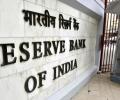
The Reserve Bank of India (RBI) has removed the prior approval requirement for non-bank entities to form tie-up arrangements for facilitating outward remittance services through banks in India, aiming to streamline the process and enhance efficiency.

'We are staying away from making forward-looking statements on when we will reach 1 trillion, etc. But growth will be rapid; it's only a matter of time.'

Rapid growth in personal gold loans has raised concerns over borrower leverage, large-ticket exposure and volatility in gold prices, points out Swaminathan J, Deputy Governor, Reserve Bank of India.

'In investing, poor sentiment is always a good vintage to build a portfolio.'

Global rating Moody's on Monday affirmed India's long-term local and foreign-currency issuer ratings and the local-currency senior unsecured rating at 'Baa3' with a 'stable' outlook on the back of robust economic growth and sound external position. The rating agency also affirmed India's other short-term local-currency rating at P-3.

India should resist knee-jerk responses to tariff volatility in the US and instead use the current geopolitical churn to build manufacturing scale at home, former G20 Sherpa and former chief executive officer of NITI Aayog Amitabh Kant said on Wednesday.

Households should moderate large discretionary expenses for the time being.
'They should prioritise essential spending. They should maintain an emergency fund covering 6 to 12 months of expenses.'

'The next phase of India's IPO cycle will be defined by quality, pricing discipline and investor selectivity.'

Leading non-banking financial company (NBFC) Shriram Finance on Friday said Japan-based MUFG Bank would invest Rs 39,618 crore, or $4.4 billion, to acquire a 20 per cent stake on a fully diluted basis through a preferential issue of equity shares.
This Budget positions India's taxation ideology as not merely a revenue source but as a strategic catalyst for growth, inclusion and long-term confidence.

'Global uncertainty is something which definitely occupies the minds of officials when we are preparing for the Budget.'
The 2026-27 Budget, seeking to harmonise the government's imperative to grant certainty while ensuring a rational tax policy, had several notable announcements to usher in halcyon days, says Mukesh Butani.

'Given that India underperformed emerging markets by 28 per cent in 2025, the worst performance in over 30 years, the timing of the sharp STT hike could have been better.'

'There is a challenge in repositioning yourself, maybe reinventing yourself.'

'Only four or five original companies remain; the rest have been replaced every decade as sectors evolve or leadership shifts.' 'Companies that fail to adapt -- like many textile mills from the 1970s and shipping firms from the 1980s -- disappear.' 'Benchmark indices reward those who reinvent themselves in line with economic demands.'

This is the first Budget in my memory of Budgets over the last half a century which has embraced upfront, enthusiastically and emphatically, technology, modernity and fiscal sobriety, notes Shreekant Sambrani.

Israel and the United States had a plan. Iran punched back. And now the Gulf is reeling, the world is beginning to feel the pain and, as on date, no one in Washington or Tel Aviv appears willing to admit that the punch has landed, notes Prem Panicker, continuing his must-read blog on the war in the Middle East.

Before signing up for a BNPL plan, read the fine print carefully and watch for red flags like unclear repayment terms, vague information on interest or late fees, and marketing that downplays the cost of default.

Only a limited set of investors should invest directly in corporate bonds.

Simplifying GST rates, removing exemptions, easing disputes, and speeding up refunds can boost investment in India and offer the best reply to Trump's tariffs, observes V S Krishnan, former member, Central Board of Indirect Taxes and Customs.

'The government is putting insurance in the same category as food, which is essential for life.' 'Now this is an opportunity for the sector to focus on the consumer.'

Reserve Bank Governor Sanjay Malhotra on Wednesday exhorted the fledgling fintech ecosystem to focus on the underserved sections of the society to deepen financial inclusion. Speaking at the annual Global Fintech Fest in Mumbai, Malhotra accepted that serving the "privileged" will be a lucrative business, but urged the smaller companies to focus on the underserved.

Mint Road's proposals on banks' M&A funding are cautious even as entrants root for more elbow room, and weigh business models.

'Some buyers get carried away by festival offers and purchase higher variants or larger vehicles than they truly need, which impacts running cost and long-term affordability.'

Crisil has assigned corporate governance 'CG' and value-creation rating 'GVC level-1' to Infosys, indicating the highest capability to create wealth for stakeholders while adopting corporate governance practices.

'I don't think it is right to remove him over one lapse. The focus should be on restoring operations, not on removing a key management personnel.'

The life and non-life insurance industries are hopeful of a reduction in the goods and services tax (GST) on health and life insurance premiums, after Prime Minister Narendra Modi, in his speech on Friday, announced GST relaxations aimed at providing relief to ordinary citizens, farmers, the middle class, and the small and medium enterprises (MSME) sector.
The Credit Rating Information Services of India Ltd (Crisil) has reaffirmed its ratings of three different fund raising programmes of Tata Iron and Steel Company Ltd (Tisco).

'India is a big market for StanC, and it is also fastest growing economy in the world.'

CPGRAMS -- an online platform available to citizens 24x7 to lodge their grievances to public authorities on service delivery -- has existed for close to two decades. But it has never been this active, points out Tamal Bandyopadhyay.

'From tariff tensions and border skirmishes to unrest in West Asia.' 'The worst may be behind us. But any further upmove will now have to come from earnings.'

Given the stronger rural activity, and potential goods and services tax (GST) impact, investors are bullish on the two-wheeler (2W) segment. In August, dealers in the domestic market picked up 11 per cent more 2Ws year-on-year (Y-o-Y), despite only 2 per cent growth in retail registrations. This indicates inventory stocking ahead of the festival season. Export trends were good. TVS Motor and Royal Enfield may have gained domestic market share.

Borrowers should consider switching from an MCLR-linked to a repo rate-linked loan.

Errors in filing income-tax returns frequently lead to scrutiny notices, additional liabilities, or delayed refunds.

'A credit line on UPI is going to make banks think about credit fundamentally as they digitise the credit process entirely.'

Salakaar is full of heart, and emotionally satisfying, applauds Syed Firdaus Ashraf.

Red Square and VDNKh easily rank among the most striking places I've visited -- both for their historical significance and architectural splendour.
My admiration for Russian culture, vision and ambition grew with every step as I clocked the miles, Nitin Sathe tells us after a visit to Moscow and St Petersburg.

The ideal time to invest in sector funds, is during a downturn so that investors can capitalise on a turnaround in 1.5 to 2 years.

Ask rediffGURU and PF expert Nitin Narkhede your mutual fund and personal finance-related questions.

'While investors believe in India's long-term growth story and resilience amid global uncertainty, they see near-term risks around the direction of a global trade war.'
 © 2026 Rediff.com - Advertise with us - Disclaimer - Privacy Policy - Sitemap - Feedback - About us - Terms of use - Grievances